

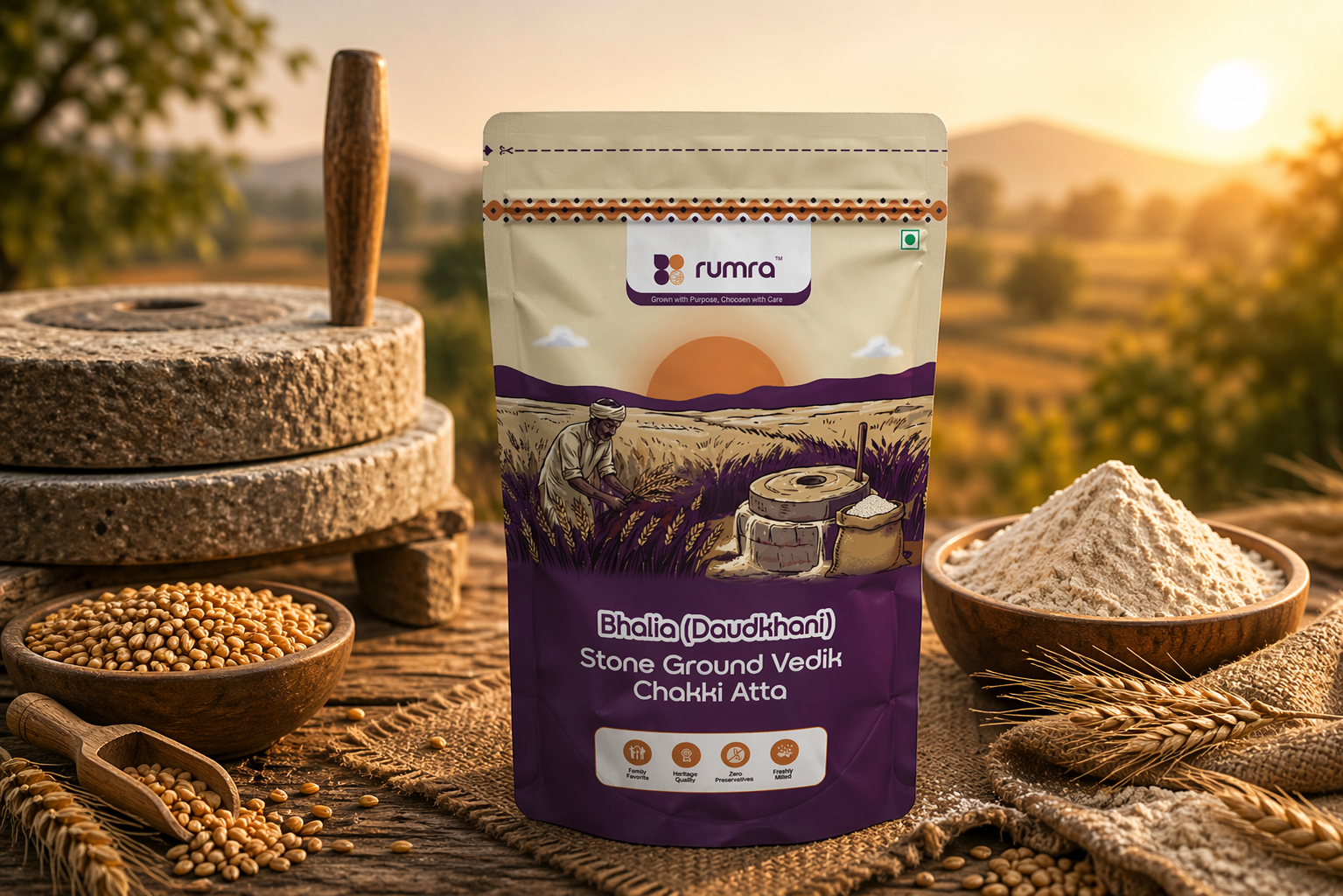
Walk into any supermarket and you will find dozens of flour brands. Every packet promises softness, whiteness, and long shelf life. But here is the question no one on those labels is answering: what happened to the grain before it became that flour?
The answer, for most packaged atta, involves high-speed roller mills that generate enormous heat — temperatures reaching 500°C to 600°C during grinding. That kind of heat does not just grind wheat. It destroys it.
Heat Is the Enemy of Nutrition
Wheat grain contains natural oils, proteins, vitamins (particularly B-complex and Vitamin E), and enzymes that are delicate by nature. When grinding temperatures spike, these nutrients are either degraded or eliminated entirely. The flour that reaches your kitchen may look like food, but much of what made the wheat nutritious is already gone.
Cold grinding — the ancient method of stone chakki milling — keeps temperatures between 45°C and 50°C throughout the process. The grain is ground slowly, with natural airflow, at a pace that the stone chakki has maintained for centuries. The result is flour that still carries the wheat's natural oils, its fibre, and its full nutrient profile intact.
The Stone Makes a Difference
It is not just the temperature. The circular motion of a stone chakki grinds the whole grain — bran, germ, and endosperm together — rather than separating and recombining them the way modern mills do. This means the fibre and the oils released from the wheat germ are naturally distributed through the flour, not added back in afterwards.
The texture is different too. Stone-ground atta has a slightly coarser, more natural feel. Rotis made from it have a flavour that processed flour simply cannot replicate.
What This Means at Your Table
When your family eats rotis made from Rumra's cold-ground chakki atta, they are eating flour that has been through one honest process: ancient stones, slow grinding, no heat damage, no additives. That is the difference between food that nourishes and food that only fills.
The Vedic chakki method was not replaced because it stopped working. It was replaced because it was slow and could not be scaled. We brought it back — because for your family's daily bread, slow and right is better than fast and compromised.
— Rumra, Ahmedabad's first stone-ground Vedic chakki atta facility
Share:
Cold-Pressed vs. Refined Oils: The Truth Your Kitchen Deserves